Einleitung zu den Schulgleitern
Der Schulgleiter SG-38 oder SG 38 ist wohl eines der bekanntesten Oldtimer-Gleitflugzeuge, da aufgrund seiner
Verbreitung in den dreißiger, vierziger und fünfziger Jahren kein Pilot am Schulgleiter zur
Anfängerschulung vorbei kam. Heute hat sich die Anzahl auf ein Dutzend flugfähige Exemplare reduziert,
weil die Anfängerausbildung schon längst nicht mehr auf einsitzigen Segelflugzeugen ausgeführt wird.
Nichtsdestotrotz erfreut sich der Schulgleiter bei Vorführungen großer Beliebtheit, sodass nicht
nur die erhaltenen Exemplare weiter gepflegt werden, sondern sogar neue Repliken entstehen.
Und daß es neben den SG 38 noch eine Reihe von weiteren Schulgleiter-Typen wie den "Hol's der Teufel"
gab und gibt, wissen nur wenige.
Diesen Schulgleitern ist die folgende Seite gewidmet.
Vorführtermine zu Flugplatzfesten, Flugtagen, Flugshows und Oldtimer-Treffen
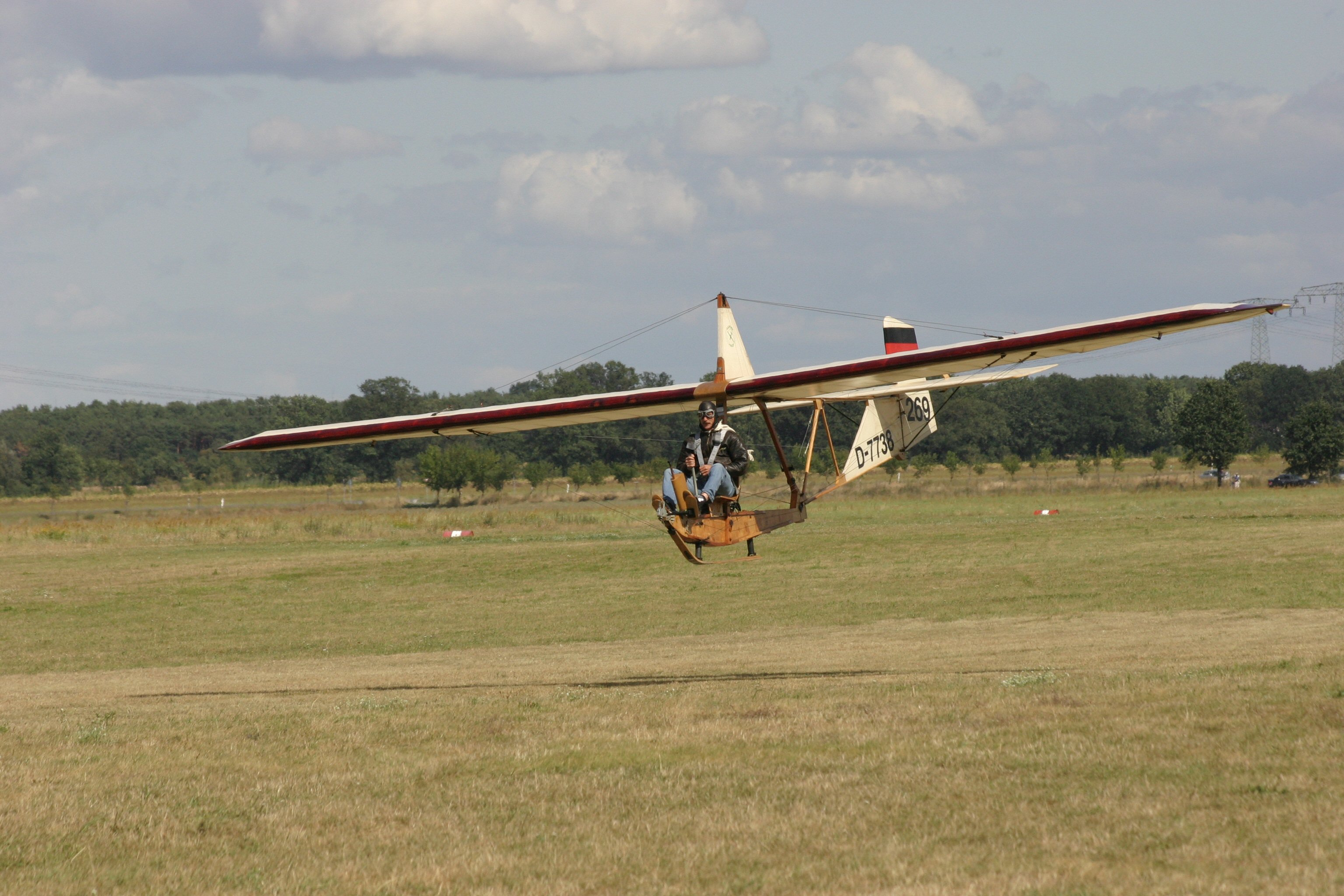
Auch in diesem Jahr möchte die Gruppe um die Oldtimer-Gleitflugzeuge Schulgleiter SG 38 (D-NNSG, D-7738, OK-A910)
und "Hol's der Teufel" (OK-A415) diese wieder auf die Reise schicken, um sie auf Flugplatzfesten und Flugtagen
zu einer Vorführung im Autoschlepp, Gummiseilstart, F-Schlepp oder im Windenschlepp starten zu lassen
oder zu ähnlichen Veranstaltungen auch nur zum Anfassen und Draufsetzen aufzustellen.
Rückblickend sind der Schulgleiter SG 38 und der "Hol's der Teufel" wahrscheinlich auf den verschiedensten
Flugveranstaltungen eine Attraktion gewesen und eine Freude für Menschen, die damals das Fliegen auf einem
Schulgleiter erlernt oder erlebt hatten. Dabei konnten die Schulgleiter sowohl bei der Flugvorführung beobachtet
werden als auch mit den Piloten Gespräche geführt werden.
Die folgenden Termine erheben keinen Anspruch auf Vollständigkeit oder Gewähr. Über die genannten Termine hinaus
sind die Oldtimer bei vielen weiteren Veranstaltungen präsent. Informationen dazu finden Sie bei den
Flugveranstaltungen selbst und in der Tagespresse. Die folgenden Links zeigen auf Einladungen zu kommenden Veranstaltungen
oder enthalten Rückblicke und Fotos auf die vergangenen Veranstaltungen.
Altenburg
Bielefeld
Brandenburg
Fotos
Göpfersdorf
Großenhain
Jahnsdorf
Jena
Kamenz
Laucha
Nardt
Neuhausen
Oschatz
Pirna
Raná
Reinsdorf
Rossitten
Salzgitter
Salzwedel
Spitzerberg
Stölln-Rhinow
Tibenham
Simplon-Pass
Schulgleiter Flug- und Vorführtermine bei Oldtimertreffen 2024
Schulgleiter Flug- und Vorführtermine bei Oldtimertreffen 2023 - Rückblicke und Fotos
Schulgleiter Flug- und Vorführtermine bei Oldtimertreffen 2022 - Rückblicke und Fotos
Schulgleiter Flug- und Vorführtermine bei Oldtimertreffen 2021 - Rückblicke und Fotos
Schulgleiter Flug- und Vorführtermine bei Oldtimertreffen 2020 - Rückblicke und Fotos
Schulgleiter Flug- und Vorführtermine bei Oldtimertreffen 2019 - Rückblicke und Fotos
Schulgleiter Flug- und Vorführtermine bei Oldtimertreffen 2018 - Rückblicke und Fotos
Schulgleiter Flug- und Vorführtermine bei Oldtimertreffen 2017 - Rückblicke und Fotos
Schulgleiter Flug- und Vorführtermine bei Oldtimertreffen 2016 - Rückblicke und Fotos
Schulgleiter Flug- und Vorführtermine bei Oldtimertreffen 2015 - Rückblicke und Fotos
Schulgleiter Flug- und Vorführtermine bei Oldtimertreffen 2014 - Rückblicke und Fotos
Schulgleiter Flug- und Vorführtermine 2013 bei Oldtimertreffen - Rückblicke und Fotos
Schulgleiter Flug- und Vorführtermine 2012 bei Oldtimertreffen - Rückblicke und Fotos
Schulgleiter Flug- und Vorführtermine 2011 bei Oldtimertreffen - Rückblicke und Fotos
Schulgleiter Flug- und Vorführtermine 2010 bei Oldtimertreffen - Rückblicke und Fotos
Schulgleiter Flug- und Vorführtermine 2009 bei Oldtimertreffen - Rückblicke und Fotos
Schulgleiter Flug- und Vorführtermine 2008 bei Oldtimertreffen - Rückblicke und Fotos
Schulgleiter Flug- und Vorführtermine 2007 bei Oldtimertreffen - Rückblicke und Fotos
| 2007-10-20 - 2007-10-21 - Oldtimertreffen |
Herbstlehrgang |
Laucha-Dorndorf |
| 2007-09-15 - 2007-09-15 - Oldtimertreffen |
Oldtimer und Gleitertreffen Laucha |
Laucha-Dorndorf |
| 2007-09-09 - 2007-09-09 - Flugplatzfest |
Luftsporttag 2007 und Besuchertag |
Klix |
| 2007-08-25 - 2007-08-26 - Flugplatzfest |
50 Jahre Flugplatz Auerbach |
Auerbach/Vogtland |
| 2007-08-18 - 2007-08-19 - Flugplatzfest |
Flugtage Bautzen |
Bautzen |
| 2007-08-18 - 2007-08-18 - Oldtimertreffen |
"Hol's der Teufel" und das Fliegen am Hutberg in Kamenz |
Am Hutberg Kamenz |
| 2007-07-20 - 2007-07-21 - Oldtimertreffen |
VGC Rendezvous 2007 |
Raná bei Louny (Tschechien) |
| 2007-07-14 - 2007-07-15 - Flugplatzfest |
Flugplatzfest Nardt |
Nardt Hoyerswerda |
| 2007-07-07 - 2007-07-07 - Flugplatzfest |
80 Jahre Fliegen |
Welzow |
| 2007-07-01 - 2007-07-01 - Oldtimertreffen |
Landesjugendvergleichsfliegen |
Pirna (bei Dresden) |
| 2007-06-17 - 2007-06-17 - Ausstellung |
Fabrik-Fest-Spiele |
Lausitzer Bergbaumuseum Knappenrode |
| 2007-06-16 - 2007-06-16 - Oldtimertreffen |
Zlin-Treffen und Tag der offenen Tür |
Kamenz |
| 2007-06-10 - 2007-06-10 - Flugplatzfest |
Fliegerfest 70 Jahre Flugplatz Bronkow |
Bronkow |
| 2007-05-19 - 2007-05-20 - Flugplatzfest |
Fliegerfest Oschatz |
Oschatz |
| 2007-05-06 - 2007-05-06 - Flugplatzfest |
Gummiseilstart-Tag |
Nardt Hoyerswerda |
Schulgleiter Flug- und Vorführtermine 2006 bei Oldtimertreffen - Rückblicke und Fotos
| 2006-10-29 - 2006-11-01 - Ausstellung |
Dresdner Herbst |
Messe Dresden Stand DAeC |
| 2006-09-16 - 2006-09-17 - Oldtimertreffen |
Oldtimer und Gleitertreffen Laucha |
Laucha-Dorndorf |
| 2006-09-09 - 2006-09-10 - Flugplatzfest |
50 Jahre Flugplatz Böhlen |
Böhlen |
| 2006-09-02 - 2006-09-02 - Oldtimertreffen |
50 Jahre Segelwiese Riesa |
Riesa-Canitz |
| 2006-08-26 - 2006-08-27 - Flugplatzfest |
80 Jahre Flugplatz Zwickau |
Zwickau |
| 2006-08-19 - 2006-08-20 - Flugplatzfest |
Flugtage Bautzen |
Bautzen |
| 2006-08-11 - 2006-08-13 - Oldtimertreffen |
10. Kleines Segelflieger-Oldtimertreffen in Stölln/Rhinow |
Stölln/Rhinow |
| 2006-07-15 - 2006-07-16 - Flugplatzfest |
Flugplatzfest Nardt |
Nardt Hoyerswerda |
| 2006-06-18 - 2006-06-18 - Ausstellung |
Fabrik-Fest-Spiele |
Lausitzer Bergbaumuseum Knappenrode |
| 2006-06-03 - 2006-06-04 - Flugplatzfest |
Flugplatzfest Kamenz AERO Lausitz |
Kamenz |
| 2006-05-20 - 2006-05-21 - Flugplatzfest |
Fliegerfest Oschatz |
Oschatz |
Ausgewählte frühere Schulgleiter Flug- und Vorführtermine bei Oldtimertreffen - Rückblicke und Fotos
| 2005 - 2005 - Flugplatzfest |
Flugplatzfeste |
Flugplätze Klix, Neuhausen |
| 2004 - 2004 - Erstflug |
Erstflug Hol's der Teufel OK-A415 |
Raná bei Louny (Tschechien) |
| 2003 - 2003 - Flugplatzfest |
Flugplatzfeste |
Taucha |
| 2002 - 2002 - Flugplatzfest |
Flugplatzfeste |
Eisenhüttenstadt, Greiz, Göpfersdorf |
| 1999 - 1999 - Erstflug |
Erstflug Schulgleiter SG 38 OK-A910 |
Raná bei Louny (Tschechien) |
| 1998 - 1998 - Flugplatzfest |
Flugplatzfeste |
Schwarzheide |
| 1997 - 1997 - Flugplatzfest |
Flugplatzfeste |
Görlitz, Langhennersdorf, Bronkow, Auerbach |
| 1996 - 1996 - Flugplatzfest |
Flugplatzfeste |
Zwickau |
| 1995 - 1995 - Flugplatzfest |
Flugplatzfeste |
Finsterwalde, Marping, Pirna |
| 1994-08-05 - 1994-08-05 - Erstflug |
Erstflug Schulgleiter SG 38 D-7738 (Grundüberholung) |
Nardt |
* Termin Teilnahme unter Vorbehalt
Geschichten über die Schulgleiter und Oldtimer-Flugzeuge
Mit dem Begriff Schulgleiter kann eine ganze Generation von Gleitflugzeugtypen bezeichnet werden, die alle etwas gemeinsam
hatten: sie waren einfach und preiswert im Aufbau, leicht zu fliegen und damit ideal für die vorherrschende
Einsitzerschulung geeignet, da im Falle eines Falles Reparaturen einfach zu bewerkstelligen waren. Und heute sind es alle
Oldtimer. Zu den Schulgleitern gehören bekannte Typen wie "Hol's der Teufel", Schädelspalter,
Zögling, SG 38, aber auch weniger bekannte Typen wie Besenstielkiste, Honza, Salamandra, T.38, G101 ..
Oldtimer-Flugzeug "Hol's der Teufel"
Als Urtyp der Schulgleiter-Familie ist wohl der Gleiter Weltensegler "Djävlar Anamma" anzusehen,
konstruiert 1923 von Alexander Lippisch. Über die Entstehungsgeschichte schreibt Fritz Stamer in seinen Erinnerungen
"Zwölf Jahre Wasserkuppe"
[2] folgendes:
Es wurde wieder einsamer auf der Wasserkuppe. Nur Dr. Allasch und Bergwyk wollten mit uns überwintern [1922/23].
Wir hatten noch eine Maschine hinzubekommen. Hangwind [Rufname von Alexander Lippisch] hatte sie entworfen, und die
Schweden hatten eifrig daran mitgebaut. Sie schlugen sich bei der ungewohnten Beschäftigung des Nagelns häufig auf die Finger.
"Djävlar Anamma" fluchten sie dann, und sie fluchten den ganzen Tag. Wir haben die Maschine dann so getauft.
"Hol's der Teufel" oder so ähnlich hieße das, hatten uns die Schweden auf Befragen mitgeteilt. In Gesellschaft
schwedischer Damen haben wir dann bald darauf ein peinliches Schweigen mit unseren schwedischen Kenntnissen verursacht.
Dieser Kernfluch hieße übersetzt unaussprechlich anders, wurde uns jetzt gestanden, doch wie - das wissen
wir leider immer noch nicht, so dass wir auch auf Nachfrage keine Auskunft geben können. Die Maschine aber, die
wir nun vorsichtshalber "Hol's der Teufel" nannten, flog ausgezeichnet, segelte bei wenig Wind, war einfach
und billig und leicht zu bauen. Sie wurde zur Stammesmutter einer ganzen Gruppe ähnlicher Maschinen. Wir glaubten in
ihr ein Übungsflugzeug geschaffen zu haben.
Der "Djävlar Anamma" von 1923 war wahrscheinlich tatsächlich der Urvater des Schulgleiters SG 38. Er wurde von
Alexander Lippisch 1923 konstruiert und besaß Spannturm und eine Rumpfstrebe vor dem Piloten. Damit gilt er wohl als erster
"Schädelspalter". Hans Jacobs verbesserte diesen Gleiter und erschuf eine Variante des "Hols der Teufel"
mit Flächenstreben und ohne Rumpfstrebe vor dem Piloten, die als erstes Serienprodukt von Alexander Schleicher bereits ab 1927
gebaut wurde. Nichtsdestotrotz sind erstaunlicherweise die Flugleistungen des "Teufels" erheblich besser als die des 10 Jahre
später in großer Stückzahl gebauten, aber wahrscheinlich preiswerteren und bekannteren SG 38.
"Hol's der Teufel" flogen in Deutschland, Ungarn und auch Namibia.
Das erste Kunststoffflugzeug
Ein besonders Detail in der Geschichte des "Hol's der Teufel" ergibt sich aus historischen
Hinweisen,
nach denen die Gebrüder Horten 1936 vor dem Bau der Horten H Va die Verwendung von Trolitax® (Verbundwerkstoff, der aus
duroplastischen Harzen als Bindemittel und Faser-Flächengebilden als Harzträger besteht) an einem "Hol's der Teufel"
ausprobierten, indem sie dessen Fläche aus Trolitax® bauten und damit wichtige Erfahrungen sammeln konnten. Gleichzeitig wäre der
"Hol's der Teufel" damit eines der ersten jemals gebauten Kunststoffflugzeuge.
Das Oldtimer-Flugzeug Hol's der Teufel OK-A415
Das neu erstandene Gleitflugzeug der tschechischen Fliegerfreunde Leník, Krejčí und den Maleschka's ist mit
Verstrebungen wie die meisten "Teufel" nach 1927 gebaut wurden. Erste Exemplare des "Teufels"
von 1927 hatten allerdings wie der SG 38 noch einen Spannturm und Seilverspannungen. Der Erstflug der Replika fand
nach über 3000 Baustunden im Mai 2004 statt. Seitdem begeistert dieses Flugzeug mit häufigen Vorführungen und der
Einladung zum Selberfliegen die Piloten und Zuschauer.
Oldtimer-Flugzeug "Schulgleiter SG 38"
Der Schulgleiter SG 38 wurde ab 1938 in der Schulung eingesetzt und ist wohl eines der am weitesten verbreiteten
Flugzeuge der Ära der Alleinflugausbildung in den vierziger Jahren.

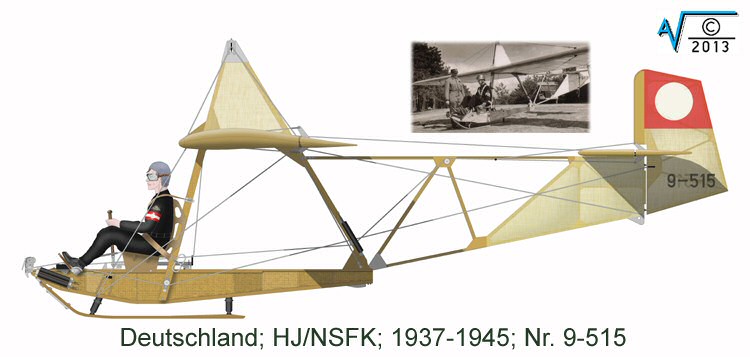
Schulgleiter der NSFK, gestaltet von © Arvo Vercamer 2013
Dieses Gleitflugzeug wurde in großer Stückzahl sowohl im Amateurbau als auch im Industriebau hergestellt und
wurde hauptsächlich zur Anfängerschulung eingesetzt.
Und auch beim Neuanfang des Segelfluges in den fünfziger Jahren begann man mit der Ausbildung auf dem
Schulgleiter.
Als Erbauer des Schulgleiters SG 38 gelten der Flugzeugbauer und Konstrukteur Edmund Schneider (Grunau-Baby),
der Konstrukteur, Prüfer und Zöglingsexperte Rehberg sowie der Produktionsleiter und Segelflieger Ludwig Hofmann
aus dem Flugzeugwerk Schneider in Grunau (Jeżów Sudecki), nahe dem heutigen Jelenia Gora in Polen. Diese hatten
wahrscheinlich bereits 1937 mehrere Prototypen des späteren Schulgleiters SG 38 entwickelt und damit begonnen, diese zu
erproben. Seine Zulassung erhielt er möglicherweise nach Testflügen bei der Fliegerübungsstelle in Rangsdorf
vom 6.12.1937 bis 25.01.1938 (Pilot Heinz Kensche) und weiteren Flügen in Grunau am 14./15.04.1938. Diese
Prototypen sollen als Zögling 37C und Zögling 37D bezeichnet worden sein, bevor die Serienexemplare dann den
Namen SG 38 trugen.
In einem Amateurfilm von 1936 (???)
[1] der "Deutsche Wochenschau Filmarchiv"
wurde über das Segelfliegen in Grunau berichtet, der neben der ESG 29 im Flugbetrieb auch einen Schulgleiter SG 38
bei der wahrscheinlichen Erprobung jener Prototypen in Grunau zeigt. Auch wenn der Film nicht kostenlos zugänglich ist,
vermitteln doch die Szenenfotos (Button "Szenenfotos anzeigen") [1] einen Eindruck von den damaligen Verhältnissen.
Möglicherweise bezieht sich die Abkürzung SG 38 eigentlich nicht auf die Bezeichnung Schul-Gleiter,
sondern auf Schneider in Grunau 1938. Dieser Zusammenhang ist jedoch nicht eindeutig belegbar.
Neben dem "Hol's der Teufel" wurde der Schulgleiter SG 38 aus den Mustern Zögling 31 und Zögling 35
sowie der Grunau 9 (dem später legendären "Schädelspalter" ESG 29 -
Einheits-Schul-Gleiter oder Espenlaub Schneider
in Grunau 1929) weiterentwickelt. Dieses Flugzeug eignete sich besonders für die damals
übliche Einsitzer-Schulung, da es auch härtere Landungen leicht wegstecken konnte. Tausende von Piloten
machten ihre ersten Sprünge auf einem SG 38 und kaum ein Gleitflugzeug wurde häufiger gebaut und geflogen ..

15 Jahre Entwicklungsarbeit an einfachen Gleitflugzeugen brachten 1938 den ausgereiftesten Schulgleiter
als Einheitstyp für die Anfängerschulung hervor. Durch die Verbesserung des Zöglingprofiles konnte eine
Leistungssteigerung erreicht werden. Neben den industriell gefertigten Exemplaren entstanden in den folgenden
Jahrzehnten auch in den Segelflugvereinen eine weitgehend unbekannte Menge. Er flog in vielen Ländern
wie Deutschland, Schweden, Polen, Lettland, Belgien, Spanien und war auch in der
DDR bis etwa 1960 das Standard- Schulflugzeug.

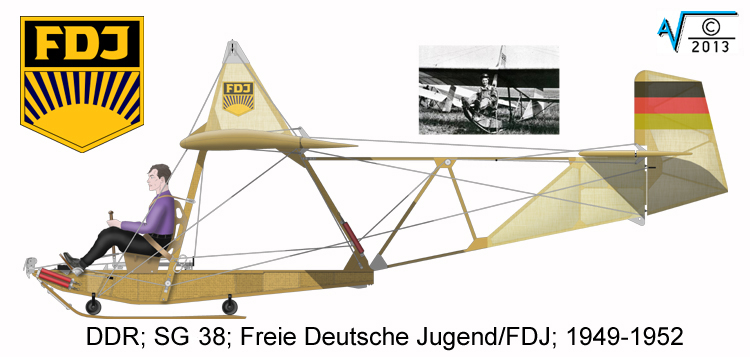
Schulgleiter der FDJ, gestaltet von © Arvo Vercamer 2013
In den 50er Jahren wurden im VEB NAGEMA Schmiedeberg sowie im VEB Lokomotiv- und Waggonbau
Gotha
eine große Anzahl von Schulgleitern gebaut. In Großbritannien produzierte die Firma
EoN den Gleiter als AP.7 Eton sowie die Firma
Slingsby den Gleiter als T.38 (Grasshopper genannt).
Dabei erhielt er einige Änderungen an Tragfläche und Leitwerk. Original wurden Bausätze als G101 von der
Firma AB Flygindustri in Halmstad (Schweden) gebaut, unter anderem für die Grundausbildung in der schwedischen Luftwaffe.
Insgesamt werden über die Jahrzehnte mit Sicherheit mehr als 8.750 Exemplare von diesen Typen gebaut worden sein.
Aufbau
Durch den einfach gehaltenen Aufbau eignete sich der SG 38 zur serienmäßigen Herstellung in Flugzeugwerften,
aber auch zum Bau in Fliegergruppen.
Der Schulgleiter SG 38 ist ein stahldrahtverspannter Hochdecker in Holzbauweise. Der Rumpf, Spannturm und
Gitterschwanz bilden ein ebenes Holzfachwerk. Der Flügel ist zweiteilig und hat eine geringe V-Form.
Gespleisste Drahtseile zwischen dem Spannturm oben und dem Rumpf unten geben der Fläche den notwendigen Halt.
Der als Gitterschwanz ausgebildete Leitwerksträger wird mit Bolzen am Spannturm angesteckt. Die Anlenkung
der Ruderflächen erfolgt über zahlreiche Drahtseile und Umlenkrollen, die am Rumpf, Gitterschwanz, sowie
in den Tragflächen angebracht sind. Die Verwindungen der Querruder am Ruderaußenende nach oben dienen
der Querstabilität und beugen Randbogenbeschädigungen am Boden vor. Zum Austrimmung werden je nach Gewicht
des Piloten Bleigewichte vor den Steuerpedalen bzw. am hinteren Spannturm angebracht. Die gefederte Kufe
ist aus Eschenholz gefertigt.
Das Oldtimer-Flugzeug Schulgleiter SG 38 D-NNSG des Aeroklub Hoyerswerda e.V. in Nardt
Gegenwärtig gibt es noch einige flugfähige Gleiter in Deutschland, davon
3 Exemplare aus der DDR-Zeit. Der Schulgleiter SG 38 mit der heutigen Zulassung D-NNSG wurde
am 28.10.1953 in Dienst gestellt und flog bis zum 19.07.1967 unter seiner Zulassungsnummer 269 am Flugplatz Bronkow.
Der eingesetzte Leim begrenzte die Lebensdauer des Fluggerätes auf 15 Jahre. Nach jahrzehntelanger Unterbringung
an den Flugplätzen Nardt (Sachsen) und Bronkow (Brandenburg) wurde der Schulgleiter von den Fliegerkameraden
des Aeroklub Hoyerswerda e.V. unter Leitung des Werkstattleiters Herbert Hansel zwischen 1992 und 1994 grundüberholt.
Am 05.08.1994 wurde das Flugzeug durch den Fluglehrer Heinz Mehlhose erneut eingeflogen. Seit dem 05.07.2006 ist der
SG 38 als D-7738 für den Flugzeugschlepp zugelassen. Seit August 2013 besitzt der Schulgleiter SG 38 seinen
eigenen Pendelbock zur Anfängerschulung.
Am 16.01.2017 wurde der SG 38 als D-NNSG "Luftsportgerät - UL-Segelflugzeug" zugelassen.
Herzlichen Dank an alle Unterstützer des Projektes zur UL-Zulassung des Schulgleiters SG 38 beim Aeroklub Hoyerswerda:
Gerhard Maleschka (Grundüberholung), Jirí Leník (Grundüberholung sowie Leihe eines Ersatz-Flugzeugs, des tschechisch
zugelassenen SG 38 OK-A910), Sven Brandhorst (Zulassung), Vattenfall GmbH (Spende).
Die Lackierung und die Kennzeichnung (außer dem jetzigen Kennzeichen) sind originalgetreu. Der Schulgleiter
dient heute als Oldtimer und fliegender Zeitzeuge der Luftfahrtgeschichte.
Das Oldtimer-Flugzeug Schulgleiter SG 38 OK-A910 von Jirí Leník in Raná/Tschechien
Die OK-A910 wurde erst 1999 erbaut und hat nach meiner Kenntnis folgende hübsche Geschichte erlebt:
Viele Jahrzehnte lagen geschweißte und gebohrte Metallteile, sogenannte Beschläge, in einer Holzkiste
im Flugzeugmuseum von Prag. Lange Zeit wußte man damit nichts anzufangen, bis eines Tages ein Oldtimer-Freund
die unbekannten Beschläge dem Schulgleiter SG 38 zuordnete und auf die Idee kam, doch den zugehörigen
Schulgleiter auferstehen zu lassen. Also begannen tschechische Fliegerfreunde um Jirí Leník damit, den
Schulgleiter mithilfe alter Pläne und viel Mühe wieder aufzubauen. 1999 hatte dieser Schulgleiter
seinen erfolgreichen Erstflug.
Aufrund der Entwicklungszeit von 1938 und dem Bau von 1999 gehört wohl dieser Schulgleiter zu den ältesten
und neuesten Flugzeugen zugleich. Die Kennung OK-A910 deutet auf seine Zulassung als Ultraleicht-Gleitflugzeug
hin. Mit seinen 115 kg Eigengewicht passt er sehr gut in diese Kategorie, obwohl es diese 1938 noch gar
nicht gab.
Oft gestellte Fragen zum Schulgleiter SG 38
Im folgenden möchte ich einige oft gestellte Fragen zum Schulgleiter beantworten.
Die Antwort entsprechen dabei meiner persönlichen Meinung und Erfahrung. Weitere Fragen können
gern gestellt oder auch konstruktive Antworten gegeben werden.
Ist Schulgleiterfliegen gefährlich?
Nein, eigentlich nicht. Herunterfallen kann man nicht, da man mit sicheren 4-Punkt-Gurten
fest am Schulgleiter angeschnallt ist. Ein Fallschirm findet aus Platz- und Massegründen keine Verwendung,
dieser macht bei dem genutzten Einsatzprofil bis in Höhen von 300m auch keinen Sinn.
Natürlich hat der Schulgleiter im Falles eines Unfalles kein Sicherheitscockpit und keine Airbags.
Deshalb gilt auch hier, stets entsprechende Vorsorge zum sicheren Fliegen zu treffen. Der Schulgleiter wird
in gleicher Weise wie die "normalen" Segelflugzeuge gewartet und geprüft. Jährlich besteht der SG 38
eine sogenannte Jahresnachprüfung. Zusätzlich finden ab und zu Belastungstests statt, die den SG 38 bis auf
das zulässige Maß unter kontrollierten Bedingungen belasten und dessen Festigkeit belegen.
Letztlich ist der SG 38 original mit einem Gurtkraftbegrenzer ausgestattet, der bei einem Aufprall die
Gurte maßvoll nachgeben lässt.
Zum Schulgleiterfliegen muss man bestimmt mutig sein und darf sicher keine Höhenangst haben?
Auch hier nein. Mut braucht man zum Segelfliegen eigentlich nie, da es bei Einhaltung aller
Regeln ein sehr sicherer Sport ist. Und Höhenangst spielt meineserachtens auch keine Rolle. Ich selbst
habe Höhenangst und stehe nur unsicher vor einem Abgrund. Aber diese Höhenangst hat nichts mit dem
Fliegen des offenen Schulgleiters zu tun, weil das Gefühl des Abgrunds fehlt. Vielmehr erfährt man bei
der Ausbildung und beim späteren Fliegen das Gefühl, selbst Teil des Flugzeuges zu sein bzw. selbst
Fliegen zu können. Man fühlt irgendwann das Flugzeug, das einen umgibt, nicht mehr, sondern hat nur
noch das Gefühl des Fliegens. Und das gibt Sicherheit. Dann spielt es auch keine Rolle mehr, ob das
Flugzeug offen und geschlossen ist.
Aber der Sitz auf dem Schulgleiter ist ja ganz frei!
Und dies hat sogar gleich mehrere Vorteile: Erstens sind die Sicht nach draußen und das Fluggefühl gigantisch.
Zweitens konnte der Lehrer bei der damaligen Einsitzer-Anfängerschulung den Schüler genau beobachten.
Drittens erleichtert die offene Bauweise die schnelle Kontrolle aller wichtigen Teile.
Viertens ist diese Bauweise natürlich sehr preiswert.
Und letztlich, das war wohl der wichtigste Aspekt aus damaliger Sicht, bietet diese Bauart einen gewissen
Schutz vor Verletzungen durch scharfkantige Flugzeugteile bei einer Bruchlandung.
Die heutigen Schulgleiter haben ja Instrumente, das hatten die Originale nicht, oder?
Richtig. Die originalen Schulgleiter hatten keine Instrumente, diese waren für den vorgesehenen
Ausbildungszweck auch nicht notwendig. Dazu schreibt Fritz Stamer in seinem
"Handbuch für den Jungsegelflieger" zur Anfängerschulung ganz richtig:
Fliegen ist Geschwindigkeit. Man könnte also auch nach einem Geschwindigkeitsmesser fliegen.
Da nun aber jedes Instrument Störungsmöglichkeiten unterworfen ist, andererseits fliegerisches Gefühl
sich kaum in gewünschtem Maße entwickeln wird, wenn der Schüler sklavisch nach einem Instrument fliegt,
ist es schon besser, zuerst weniger nach Geschwindigkeit als vielmehr nach der richtigen Lage
des Flugzeuges in der Luft zu fliegen.
Da die in Deutschland zugelassenen Schulgleiter allerdings die
Bauvorschriften von Segelflugzeugen erfüllen müssen, ist eine Mindestinstrumentierung Pflicht. Auch
ist es für viele heutige Piloten nur schwer einsehbar, daß man ein Flugzeug sehr wohl völlig ohne Instrumente
fliegen kann. Im übrigen sind die Nachrüstungen der Instrumentenpilze in Eigeninitiative von den Haltern
ausgeführt wurden, sodass sich die Schulgleiter auch anhand ihrer Instrumentenbretter gut unterscheiden lassen.
Die Schulgleiter taugen doch nur für kurze Sprünge, nicht wahr?
Nicht ganz. Auch mit den Oldtimer-Gleitflugzeugen sind respektable Strecken zu fliegen.
Folgender Flugbericht aus Grunau, dem heutigen Jeżów Sudecki, über
einen freien 50 km Vieleck-Flug 2008 von Ulf Kern
beweist, daß die Oldtimer noch lange nicht zum alten Eisen gehören.
Inzwischen hat Ulf Kern einen 101 km Streckenflug mit dem
Hol's der Teufel erflogen und damit alle Bedingungen für die Silber-C auch auf diesem Oldtimer
erreicht.
Am Höhenmesser und im Kennblatt ist eine maximale Flughöhe über Grund von 300m festgelegt. Warum?
Im Musterblatt (heute Gerätekennblatt) der Prüfstelle für Luftfahrtgerät von 1938 steht zum Schulgleiter:
Bemerkung: In Prüfschein eintragen: Größte Flughöhe über Grund: 300m, Ohne Boot bzw. Blickvisier,
für Schulflüge mit B- und C-Aufträgen nicht zugelassen.
Diese Einschränkung ist noch immer gültig! Ursprünglich war sie sicher dazu gedacht, die Gleitflugzeuge
(Anfängerschulung mit geringer Belastung) von den Segelflugzeugen (Fortgeschrittenenschulung mit Kunstflug und höherer
Belastung) abzugrenzen. Dazu sind die Schulgleiter in die Lufttüchtigkeitsgruppe:
"Beanspruchungsgruppe 1 der BVS" eingetragen. Geringe Beanspruchung bedeutet: Anfängerschulung, kein Kunstflug,
kein F-Schlepp, nur für Gummiseilstart, Kraftwagen- und Windenschlepp zugelassen, maximal 300m hoch.
Weiterhin hatten die Gleitflugzeuge üblicherweise keinerlei Instrumente und oft auch kein Boot, um die geflogene
Geschwindigkeit sicher beurteilen zu können.
Deshalb gilt meineserachtens diese Einschränkung nach wie vor für alle in Deutschland nach BVS (Bauvorschriften
für Segelflugzeuge) zugelassenen Schulgleiter. Die tschechischen Schulgleiter sind, da als UL-Gleitflugzeuge
zugelassen, davon nicht betroffen.
Welche Schlepp-Kupplung wird am Schulgleiter SG 38 verwendet?
Unser SG 38 hat eine modifizierte
"Sicherheitskupplung Europa G72"
des Herstellers "Tost". Original wurden solche Kupplungen nicht verbaut, sondern nur der Haken
für den Gummiseilstart. Wenn jedoch eine Kupplung verwendet wurde, wurde sie nach meinen Informationen
als Fertigteil gekauft und ist deshalb auch nicht auf den Zeichnungen zum Selbstbau enthalten. Die SG 38
setzen verschiedene Kupplungen ein, beispielsweise nutzt der tschechische SG 38 eine original
NSFK-Kupplung (siehe auch Bauberichte), welche eine automatische
kreisförmige Auskuppelvorrichtung an der Kupplung besitzt.
Gibt es eigentlich einen Unterschied zwischen den Bezeichnungen Gleitflugzeug und Segelflugzeug?
Ja. Fritz Stamer schreibt dazu:
Für Gleitflugzeuge, welche zu Schulungszwecken Verwendung finden, werden bestimmte
Bedingungen gefordert, die darauf beruhen, daß das Anfänger-Gleitflugzeug die größtmögliche Sicherheit beim Schulen
gewährleisten soll. Diese vom Forschungsinstitut der Rhön-Rossitten-Gesellschaft aufgestellten Bedingungen lauten:
- Das Seitenverhältnis des Flugzeuges soll 9 nicht übersteigen, d.h. das Quadrat der Spannweite geteilt
durch den Flügelinhalt soll nicht größer als 9 sein.
- Die Flächenbelastung des Flugzeuges soll nicht kleiner als 8kg pro m² sein.
- Das Tragwerk soll verspannt oder verstrebt gebaut sein.
- Das Seiten- und Höhenleitwerk soll aus Flossen und Rudern bestehen.
Außerdem werden die Gleitflugzeuge in den Bauvorschriften für Segelflugzeuge (BVS) als besondere Lufttüchtigkeitsgruppe
geführt, nämlich als Beanspruchungsgruppe 1 (geringe Beanspruchung). Damit war und ist der Schulgleiter auch für den
Amateurbau in Deutschland zugelassen. Weitere Beanspruchungsgruppen wurde entsprechend des Verwendungszwecks bis zur
Beanspruchungsgruppe 5 von Segelflugzeugen geführt.
Warum hat der Schulgleiter SG 38 OK-A910 eine tschechische Flagge am Heck?
In den dreißiger Jahren wurde auch auf dem Gebiet des damaligen Sudetenlandes, welches heute in Tschechien liegt,
Segelflug betrieben. Und so flogen auch die deutschen Schulgleiter SG-38 in Rannay (dem heutigen Raná) und anderswo.
Jirí Leník baute seinen Schulgleiter OK-A910 mit Beschlägen und Originalteilen aus jener Zeit in Raná neu auf und ließ diesen
Schulgleiter SG-38 im heutigen Tschechien als UL-Gleitflugzeug zu. Da die Oldtimer-Gruppe um Jirí Leník recht aktiv ist,
sieht man die OK-A910 mit ihrer tschechischen Flagge auch sehr häufig in Deutschland fliegen.
Gibt es Detailaufnahmen vom Schulgleiter SG 38?
Zur Unterstützung gibt es eine Modell-Galerie von Fotos mit
Detailaufnahmen von SG 38 Baugruppen. Alle Minibilder können durch Klick auf das Format 3264x2448 vergrößert werden.
Sollten Details fehlen, können diese auf Nachfrage gern eingestellt werden. Weitere Informationen sind im Zeichnungssatz,
in den Zeichnungen und technischen Unterlagen zum Schulgleiter SG 38 zu finden.
Gibt es auch neue Gummiseile zu kaufen?
Ja.
Literaturverzeichnis
[1] Deutsche-Wochenschau Filmarchiv - 2012
[2] "12 Jahre Wasserkuppe" - Fritz Stamer - Berlin 1933
Kontaktmöglichkeiten
Per EMail an info@schulgleiter.de oder telefonisch Alexander Görnitz über den Aeroklub Hoyerswerda e.V. - Flugplatz Nardt
.. und weil es mir wichtig ist
Als Kind wurde mir erklärt, daß es Gut und Böse gibt. Aber das ist ein Trugbild.
Es gibt nur die Ungerechtigkeit aus Arm und Reich aufgrund der persönlichen Gier.
Und deshalb ist auch die aktuelle Frage nach "Profit oder Klimaschutz" nur eine Ausprägung des Übels.
.. Es ist nicht uns're Schuld, daß die Welt ist wie sie ist,
es wär' nur uns're Schuld, wenn sie so bleibt .. Frei nach 'Die Ärzte'
 Was Staat, Politik, Privatbesitz, Imperialismus und Krieg eng miteinander verbindet und warum das unserer aller Welt ruiniert?
Michael Moore erklärt es Dir in seinen aufschlußreichen Filmen aus Amerika.
Was Staat, Politik, Privatbesitz, Imperialismus und Krieg eng miteinander verbindet und warum das unserer aller Welt ruiniert?
Michael Moore erklärt es Dir in seinen aufschlußreichen Filmen aus Amerika.
 "Finanzkapitalismus und rechtes Denken" in unserer Gesellschaft verstehen lernen mit dem Känguru und Marc-Uwe Kling!

Informier' Dich, was wirklich auf unserer Welt und in Deutschland passiert!

Informier' Dich, warum die Welt Dich etwas angeht und wie Du menschlich Demokratie leben kannst, die unsere Welt ein Stückchen besser macht!
|

Kein giftiges Geschenk - Bienensterben stoppen:
Agrarministerin Julia Klöckner (CDU) will verbotene Bienengifte - sogenannte Neonicotinoide - wieder auf die Äcker lassen.
Dabei hat die EU die Gifte längst verboten.
Unterzeichne mit uns den Eil-Appell von campact.

Schütze unsere Umwelt! Denn Geld kann man nicht essen.

|